

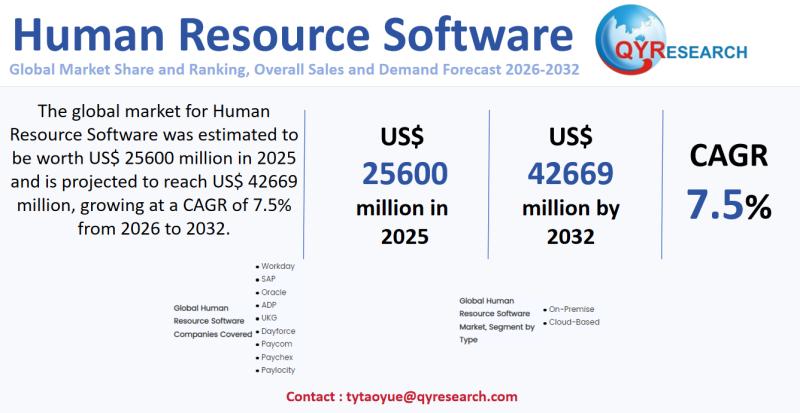
Global Growth Forecast for Human Resource Software Market
The global human resource software market is poised for significant expansion between 2026 and 2032, driven by digital transformation and the increasing need for streamlined HR processes. Businesses across various sectors are adopting advanced HR solutions to enhance productivity, improve workforce management, and ensure compliance with evolving labor laws.
According to recent research, the market is expected to witness robust growth due to factors such as cloud-based deployment, AI integration, and the growing emphasis on data-driven decision-making in human resource management.
Key Market Trends Impacting Growth
One of the most influential trends shaping the HR software market is the shift to cloud-based solutions. Organizations of all sizes are moving away from on-premise systems in favor of scalable, cost-effective cloud platforms. This transition offers benefits such as remote accessibility, real-time updates, and reduced IT maintenance costs.
Another significant trend is the integration of artificial intelligence (AI) and machine learning (ML) into HR processes. These technologies are enhancing recruitment through resume screening, predictive analytics, and automated communication. They also support employee engagement by providing personalized learning paths and performance insights.
Additionally, the demand for mobile-friendly HR platforms has surged, reflecting the increase in remote and hybrid work models. Mobile access allows employees to manage tasks like attendance, leave applications, and benefits enrollment from any location, improving overall efficiency.
Regional Market Dynamics
North America currently leads the human resource software market, supported by the presence of major tech companies and early adoption of advanced digital tools. The United States, in particular, is a key contributor due to its large enterprise base and focus on workplace innovation.
Europe follows closely, with countries such as Germany, the United Kingdom, and France investing heavily in HR technology to comply with stringent labor regulations and enhance employee satisfaction.
Asia-Pacific is emerging as a high-growth region, propelled by rapid digitization in countries like India, China, and Japan. The growing startup ecosystem and increasing demand for efficient HR solutions in small and medium enterprises (SMEs) are fostering market growth in the region.
Competitive Landscape and Leading Players
The HR software market is highly competitive, with both established players and new entrants vying for market share. Key companies in the space include Workday, SAP SuccessFactors, Oracle, ADP, and BambooHR. These vendors are continuously innovating their offerings to stay ahead in the market.
Strategic collaborations, mergers, and acquisitions are common strategies used by these companies to expand their global footprint and enhance product capabilities. For instance, many firms are integrating HR platforms with third-party applications to provide a seamless user experience and cater to specific industry needs.
Future Outlook and Opportunities
Looking ahead, the human resource software market is expected to continue its upward trajectory through 2032. The growing importance of employee experience and engagement will shape the development of future HR tools. Companies are increasingly investing in solutions that support mental wellness, diversity and inclusion, and continuous feedback mechanisms.
Moreover, advancements in data analytics and reporting will empower HR departments to make more informed decisions. Predictive analytics will be instrumental in talent acquisition, retention strategies, and workforce planning.
The rise of gig economy and freelance workforce is also creating new demands for flexible and scalable HR software that can manage contract workers efficiently.
Conclusion
In conclusion, the global human resource software market is on a steady growth path, fueled by technological advancements and the evolving needs of modern workplaces. Organizations that embrace digital HR tools will be better positioned to attract and retain top talent, ensure compliance, and drive organizational success over the next decade.
This article is inspired by content from Original Source. It has been rephrased for originality. Images are credited to the original source.