

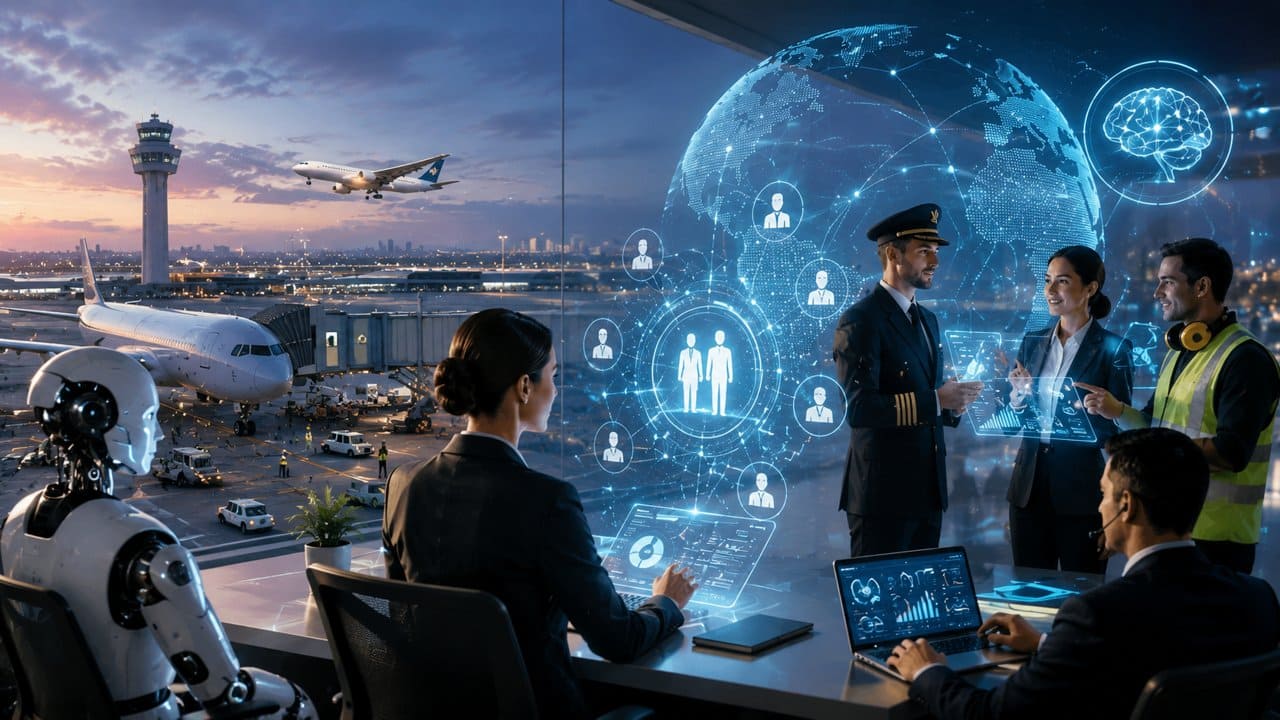
The Future of HR in Aviation: AI-Driven Transformation
The aviation industry is undergoing a profound transformation, with artificial intelligence (AI) poised to redefine every facet of its operations. One of the most significant changes on the horizon is the evolution of the human resources (HR) function. By 2035, the concept of the Aviation Workforce & Culture Command (AWCC) will emerge, fundamentally reshaping how aviation organizations manage their people. This article explores how AI in aviation HR will foster new roles, capabilities, and a culture of resilience, safety, and innovation.
Introducing the Aviation Workforce & Culture Command (AWCC)
The AWCC represents a leap beyond traditional administrative HR. Instead, it embodies a human-centered approach to operational governance, leveraging advanced technologies to nurture talent and drive organizational performance. Unlike legacy HR functions, the AWCC is designed to orchestrate a seamless partnership between humans and AI, ensuring that the workforce remains adaptive, skilled, and future-ready.
Core Capabilities of the AWCC
The AWCC will be defined by a set of cutting-edge capabilities that set it apart from conventional HR departments. Among these, AI in aviation HR will enable:
- Human-AI Teaming Governance: Managing dynamic teams composed of human professionals and AI agents, ensuring optimal collaboration and ethical oversight.
- Competency Telemetry & Workforce Analytics: Deploying sophisticated analytics to monitor skills, productivity, and readiness across the workforce in real time.
- Digital Twin Training Orchestration: Using digital replicas of employees and processes to simulate scenarios, optimize training, and predict outcomes.
- Culture, Safety & Psychological Resilience: Fostering a culture of safety and psychological well-being, supported by AI-driven insights for proactive intervention.
- Cross-Sector Talent Pipeline Architecture: Designing talent pipelines that draw from diverse industries, enhancing agility and innovation.
- Operational Readiness & Workforce Choreography: Ensuring teams are equipped, trained, and deployed effectively for all operational scenarios.
How HR Roles Will Evolve by 2035
With the integration of AI in aviation HR, traditional roles will undergo a dramatic transformation. Here’s how some key positions will evolve:
- HR Manager → Director of Human-AI Integration: This role will oversee seamless collaboration between human employees and AI technologies, balancing efficiency with ethical considerations.
- Training Manager → Digital Twin Training Orchestrator: Rather than focusing solely on conventional training, this leader will coordinate immersive digital twin simulations for continuous learning and skill development.
- Talent Acquisition → Cross-Sector Workforce Architect: Talent leaders will craft workforce strategies that span multiple sectors, ensuring access to a diverse pool of skills and experiences.
- HR Business Partner → Culture & Resilience Strategist: The focus here will shift to nurturing organizational culture and building psychological resilience, leveraging AI-driven analytics for early detection and intervention.
- L&D Specialist → Competency Telemetry Analyst: Learning and development professionals will analyze telemetry data to identify skill gaps and customize learning pathways.
Human-AI Teaming: The New Paradigm
The future of AI in aviation HR rests on effective human-AI teaming. By 2035, it will be vital for HR leaders to orchestrate collaboration between people and machines, ensuring that technology enhances—rather than replaces—human potential. This requires a focus on digital literacy, change management, and ethical governance.
Organizations will need to foster a growth mindset, encouraging employees to view AI as a collaborative partner. Training programs will shift towards building hybrid competencies, blending traditional aviation expertise with digital fluency and adaptability.
Building a Culture of Safety and Resilience
Safety and psychological resilience will remain top priorities in aviation. With AI in aviation HR, real-time analytics will help identify stressors, predict potential safety risks, and facilitate timely interventions. The AWCC will play a pivotal role in embedding these values into daily operations and long-term strategies.
Additionally, cross-sector talent pipelines will bring fresh perspectives and innovative thinking, further strengthening the industry’s ability to adapt to evolving challenges.
Conclusion: Preparing for an AI-Driven Aviation Workforce
By 2035, the integration of AI in aviation HR will have redefined the human resources landscape. The emergence of the AWCC will empower organizations to harness the full potential of their people and technology, fostering a culture of safety, resilience, and operational excellence. As the aviation industry continues to evolve, those who embrace AI-driven HR strategies will be best positioned to thrive in a dynamic and competitive environment.
This article is inspired by content from Original Source. It has been rephrased for originality. Images are credited to the original source.