

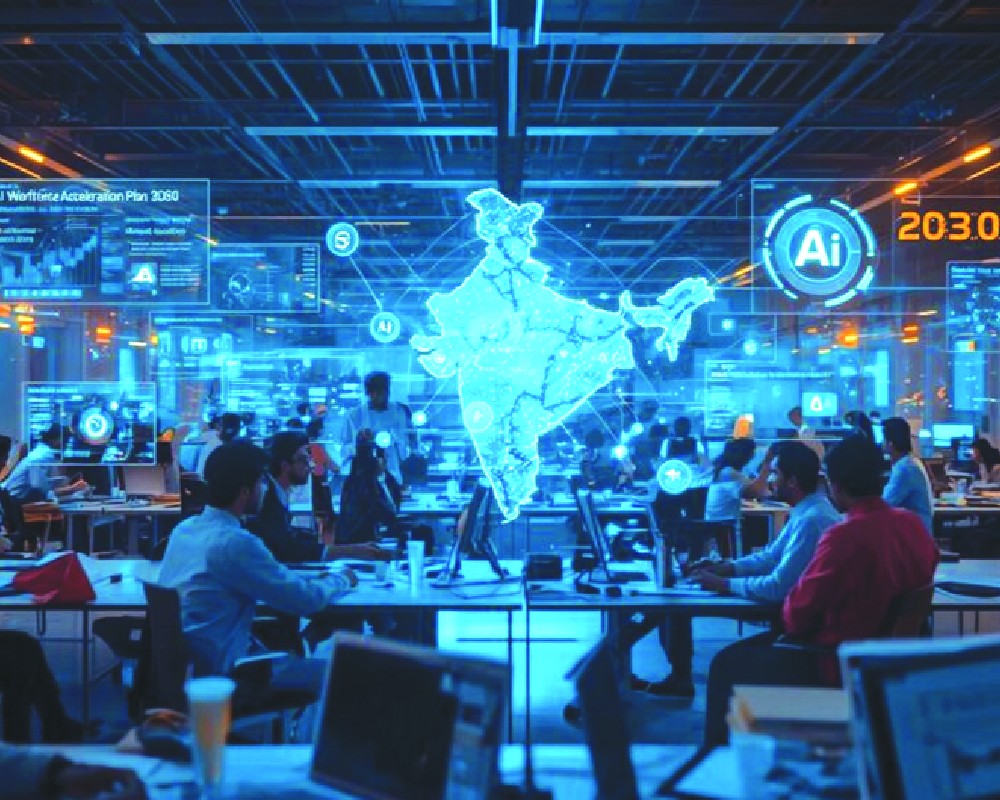
India’s Human Resources Landscape is Undergoing a Digital Revolution
Human resource management in India is experiencing a seismic shift. Gone are the days of manual processes, checklists, and administrative bottlenecks. Today, HR departments are transforming into dynamic, data-driven engines powered by intelligent systems. Technologies such as Generative AI (GenAI), Artificial General Intelligence (AGI), and quantum computing are redefining how organisations engage, manage, and evolve their workforce.
As India advances in its digital transformation, this HR revolution is being driven not only by private innovation but also by public policy. Initiatives like Digital India, the IndiaAI Mission, the National Quantum Mission, and the rollout of the new Labour Codes are collectively shaping a future where policy and technology converge to empower workers and employers alike.
Generative AI: From Automation to Intelligence
Generative AI has moved HR far beyond its traditional administrative role. While initial use cases focused on automating document creation or employee communication, Indian companies are now leveraging GenAI for more nuanced tasks. These include forecasting talent shortages, designing culturally adaptive learning paths, and generating multilingual communication tailored to India’s diverse workforce.
This evolution is turning HR into a powerful decision-making hub, blending analytical rigor with creativity and empathy. With GenAI, organisations can now simulate cultural dynamics in teams, predict workforce attrition, and tailor engagement strategies at scale.
AGI Signals a New Era of Workforce Intelligence
Though Artificial General Intelligence remains largely in the research stage, early prototypes are already making waves. These systems can reason through ambiguity, synthesize vast data inputs, and generate forward-looking insights. In HR, AGI could one day integrate economic data, employee sentiment, external labor trends, and internal performance metrics to shape future workforce models.
Rather than merely reacting to behavior, such systems will seek to understand the underlying motivations behind employee decisions. This capability can inform leadership development, diversity strategies, and national upskilling initiatives — all critical in India’s transition to a knowledge-based economy.
Agentic AI: Autonomous HR in Action
Going a step further, agentic AI introduces autonomy into HR systems. These intelligent agents can independently execute complex tasks — from talent acquisition and compensation analysis to workflow coordination and employee satisfaction tracking. Unlike basic chatbots, agentic AI combines memory, planning, and reasoning to act as true operational partners.
Public sector undertakings and large Indian corporations are experimenting with these agents to streamline hiring, monitor labor markets, and manage workforce health with minimal human intervention. Experts predict that such systems will become standard in business operations within the next decade.
Enhancing Accuracy Through RAG Systems
Retrieval-Augmented Generation (RAG) is another key pillar of this transformation. By grounding AI models in an organisation’s internal data — from policies and compliance records to case files and audit reports — RAG ensures that responses are accurate and contextually relevant.
This is especially important in India, where HR must navigate a complex regulatory landscape involving entities like the EPFO, ESIC, and state-specific labor laws. With RAG, HR departments gain access to a reliable, always-updated institutional memory, improving compliance and decision-making.
Model Context Protocol (MCP): Bridging Insight and Action
To turn insights into outcomes, the Model Context Protocol enables seamless integration between AI systems and enterprise platforms such as HRIS, ERP, payroll, and compliance tools. MCP allows for automated onboarding, dynamic role changes, and real-time workload adjustments.
This eliminates the traditional disconnect between strategy and execution, allowing HR departments to operate as agile, intelligence-driven units rather than reactive administrative bodies.
Vibe Coding: Emotional Intelligence in AI
India’s cultural and linguistic diversity demands a higher level of emotional intelligence from HR systems. “Vibe coding” is an emerging AI capability that reads emotional tones, cultural nuances, and organizational mood using multimodal inputs.
Unlike basic sentiment analysis, vibe coding can detect subtle psychological patterns, offering leaders a deeper understanding of employee morale. In today’s hybrid work environments, such emotionally attuned systems are becoming essential for empathetic and inclusive management.
Quantum Computing: The Next Frontier in HR Strategy
Quantum computing, supported by India’s National Quantum Mission, promises to revolutionize HR planning. With the ability to evaluate millions of workforce configurations simultaneously, quantum systems can solve complex optimization problems that traditional computers cannot tackle efficiently.
These technologies can enhance everything from team design and pay structures to diversity modeling and future capability forecasting. With qubits and quantum entanglement, HR tools could simulate entire organizational futures — enabling unprecedented foresight in strategic planning.
Policy and Infrastructure: Foundations of Transformation
The rollout of India’s new Labour Codes marks the most significant labor reform since Independence. These codes prioritize transparency, digitization, and consistency across states. To comply effectively, organisations will require adaptive HR systems capable of interpreting and responding to policy changes in real time.
Digital infrastructure like the Labour Stack — offering portable worker identities, authenticated skill records, and integrated social security — will further unlock India’s demographic dividend. When combined with AI, this infrastructure enables seamless talent mobility across industries and regions.
Conclusion: From Automation to Strategic Orchestration
India’s HR function is no longer limited to processing payrolls or conducting appraisals. It is transforming into a strategic orchestrator of human capital — powered by AI, AGI, agentic systems, and quantum computing. With a supportive policy environment and an innovation-driven economy, India is uniquely positioned to lead this global transition.
The future belongs to organisations that embrace these technologies not just to automate, but to cultivate systems capable of continuous learning, emotional intelligence, and strategic foresight.
This article is inspired by content from Original Source. It has been rephrased for originality. Images are credited to the original source.